
Rock Lobster

Dear Gen Xer,
A group of friends meet for dinner at Hunan Chinese Restaurant.
They’re so broke, they can’t afford food, so they pitch in and order a Flaming Volcano. It’s a bowl of rum in the shape of a mountain, mixed with juice and served with straws. It’s even got a moat around it.
The friends dig in.
They sip and laugh and sip some more. When they’re done, they drift on back to Owen’s place. He used to play in Zambo Flirt and his basement is full of instruments.
Owen heads upstairs to read his mail. The rest stick around and start to jam.
Ricky and Keith drive the music. Kate, Fred, and Cindy improvise on vocals.
Something clicks.
So many great ideas pour out it feels like their heads are going to explode. Like the basement walls will soon be covered in recycled rum.
They have so much fun that night, they wind up on the floor laughing their guts out.
The year is 1976.
The place: Athens, Georgia.
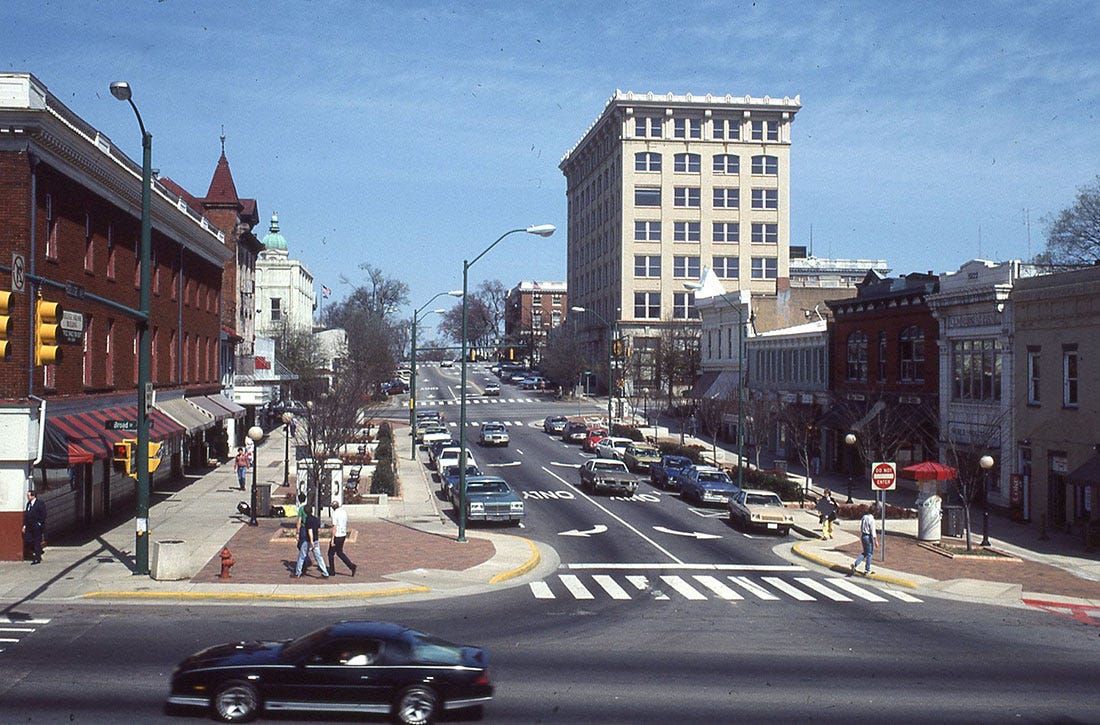
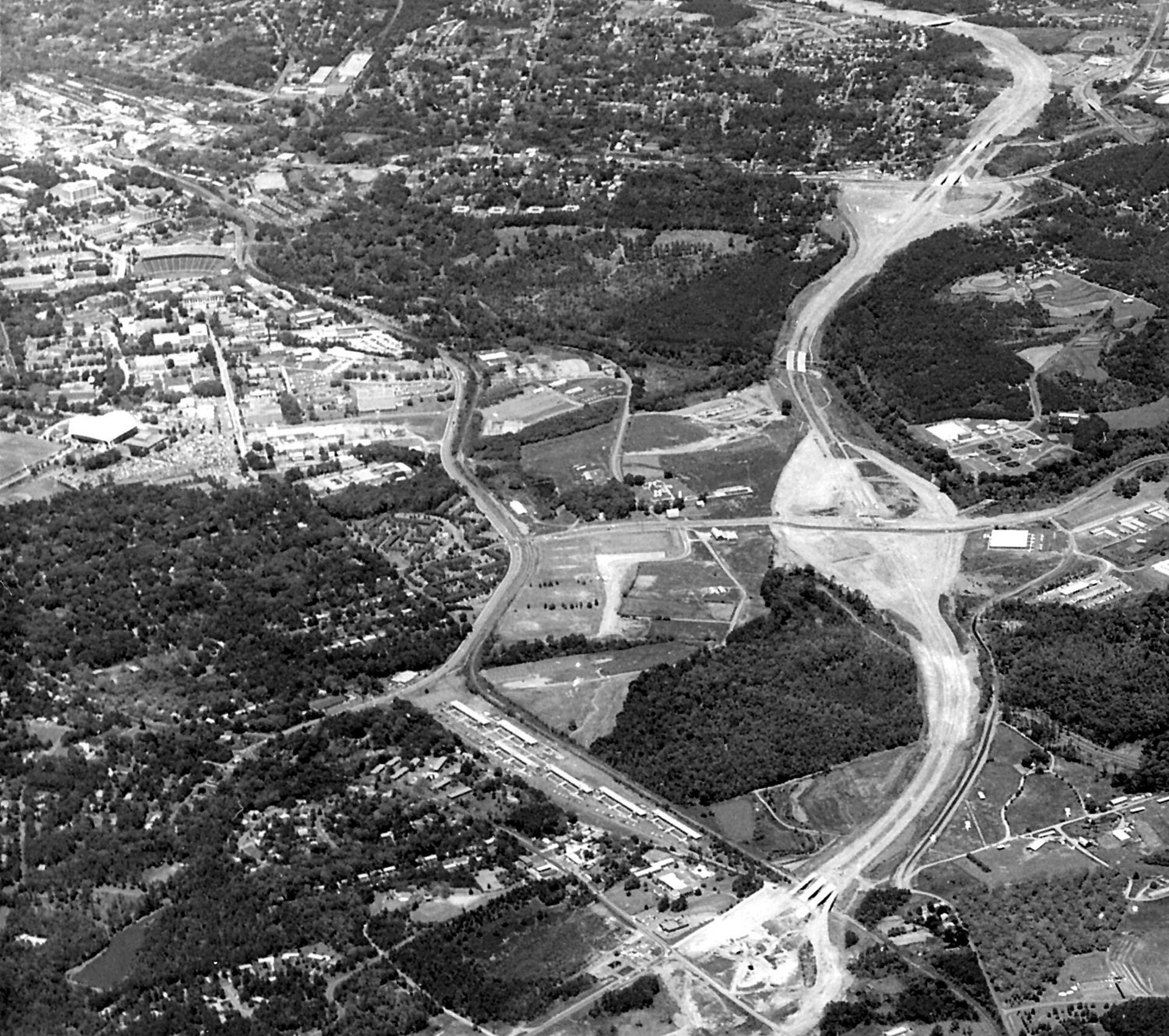
It wasn’t much more than a college town surrounded by belts of farmland.
Sure, Athens was liberal, but it wasn’t exactly chic. And yet there were rumblings of rebellion, most of which were coming from the University of Georgia.
The UGA Art Department had become a hotbed of radical thinking. It was staffed with iconoclastic teachers like Jim Herbert and Robert Croker. They were influenced by the likes of John Cage, by concepts of chance and the experimental, and proceeded to create an environment of social and artistic freedom.
The art building was open 24 hours a day. It was located next to the Georgia Museum of Art and ran along the border of downtown Athens. Students and non-students would wander through the buildings. They’d check out the artwork, hang in the hallways, watch the townies and artists go by. Later they’d attend drug-fueled parties, concerts, and art shows, often held in fields that stretched deep into the night.
They started rehearsing in the bloodletting room of a former funeral parlor.
They had to pipe electricity in from the vegetarian cafe next door. There was no heat, so Kate would play keyboards with her gloves still on. The rest would stay warm by moving around freely, wary of the ominous drains dotting the whitewashed floor.
They practiced for hours five days a week. They had no gigs, or even any prospects. They just knew they were on to something fun and unique.
Sometimes they’d use Brian Eno’s Oblique Strategies. They’d swap instruments or switch up whatever they happened to be doing. Usually, though, Keith and Ricky would work on instrumentation, Fred and Cindy would jam on vocals, and Kate would cover the keyboards and bass.
They’d play until they entered a trance, a space that felt like automatic writing, where a collective unconscious would take over the band and send them into otherworldly musical dimensions. They’d record the entire session, then listen to the tape afterwards and patch together all the best parts like some kind of sonic collage.
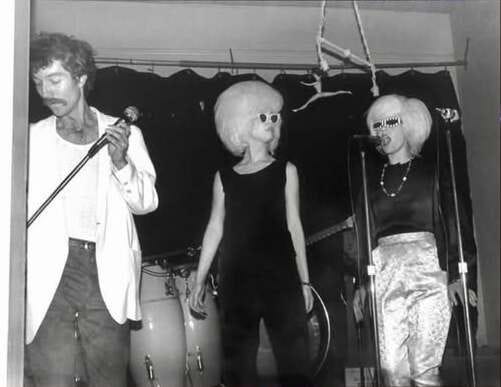
On Valentine’s Day, 1977, four months after sharing a Flaming Volcano, The B-52’s played their first gig at a house party on Milledge Avenue.
Keith pounded the bongos. Ricky played with his back turned. Cindy, Kate, and Fred stood center stage and shared the vocals.
They fought through their fear and performed four songs: Strobe Light, Planet Claire, Killer Bees, and a silly little ditty called Rock Lobster.
The song had started as a joke.
Cindy returned home one day and found her brother Ricky in the living room. He was working on some music and snickering to himself. I just wrote the stupidest riff, he said.
They both laughed as Ricky played it.
The riff had a corny beach party vibe, the kind of thing you might hear playing in an Annette Funicello flick. Yet something pulled from beneath the waves. Maybe it was the quirky open tuning. Maybe it was because Rucky was only playing the top two strings and the bottom two strings. Whatever the case, they felt the idea was worth a jam.
Ricky played the riff at the next rehearsal. Keith joined in behind the drums. Fred recited some poetry he’d written after witnessing a slide show at a disco in Atlanta: a conveyor belt of random photos of puppies and babies, hot dogs and lobsters.
Cindy and Kate contributed as well. They fooled around with lyrics and harmonies, with whatever came whispering through the ether. At some point they started making fish sounds. It was a spontaneous homage to Yoko Ono, an artist they’d admired for years.
It sounds like a hackneyed Hollywood plot:
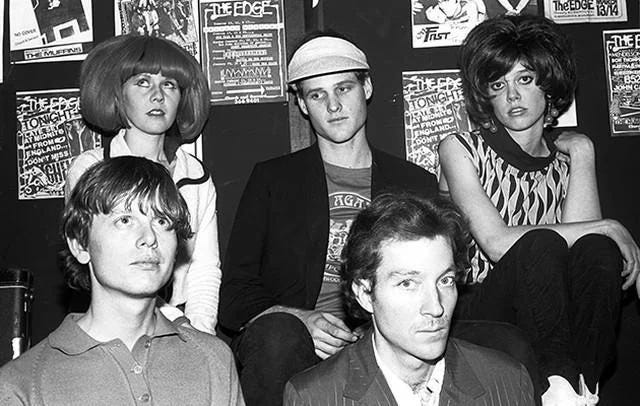
Misfits from the sleepy South play their fourth show ever as a band at one of the most iconic venues in New York City.
But that’s exactly what happened.
Ten months after their Valentine’s gig, after sending away demo tapes and finally hearing back, the B-52’s strapped their equipment to the hood of a station wagon and embarked on a 20-hour jaunt to the Big Apple.
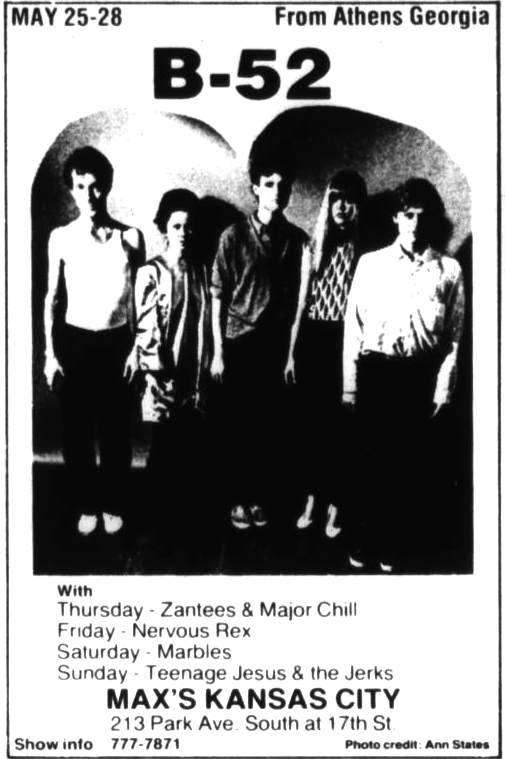
Their final destination was 213 Park Avenue South, home to a nightclub and restaurant called Max’s Kansas City.
Every cutting-edge artist played there: Lou Reed, Blondie, Patti Smith, The Ramones.
A gig at Max’s Kansas City meant you were good enough to share the stage with the culture’s elite. It was a remarkable feat for a band that was less than a full year old, for a quirky congregation of rainbows and hair that looked and sounded nothing like their moody, black-clad counterparts.
There couldn’t have been more than 20 people at the gig. But it marked the first time that The B-52’s performed for somebody other than their friends and they were appropriately terrified.
A funny thing happened, though, when they began to play.
The dour-faced denizens, who were used to leaning against the walls, arms crossed in perpetual defiance, loosened up and began to dance.
The fun didn’t last very long, however. There were tons of bands on the bill, so The B-52’s were limited to a 20-minute set.
Twenty hours of driving for a twenty minute show in front of 20 strangers.
It. Was. Worth it.
Especially when a couple of musicians approached them after the show. Their names were Lux and Ivy, they said, and they loved what the band was doing.
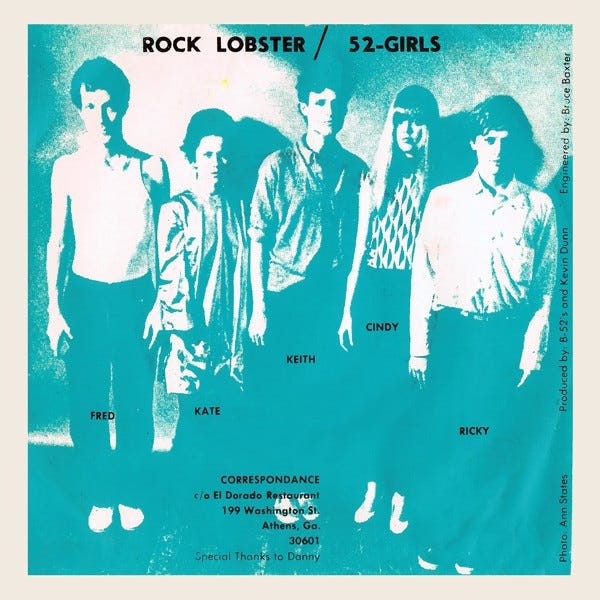
Danny Beard, owner of Atlanta’s Wax’n’Facts record shop, suggested The B-52’s release a single on his new label, DB Records.
The point was to make a one-off record, something that would help the band acquire gigs and a proper manager.
The B-52’s entered Stone Mountain Studios in Atlanta in February 1978 and wound up recording two songs: 52 Girls and Rock Lobster.
The latter was recorded in eleven hours for the whopping sum of $400. This initial version is different from the one that would eventually appear on their debut album. Fred’s delivery is somewhat restrained, and the song is missing an entire verse. Nevertheless, the song was released, and reviews of Rock Lobster began appearing in underground magazines around the country.
The band was invited back to New York, not just to play Max’s Kansas City, but other popular venues as well. This became standard practice. They’d make the pilgrimage to NYC, play at CBGB, Hurrah, and Mudd Club, then drive back home when they were done: thrilled, exhausted, and hungry for more.
By 1979, the single for Rock Lobster had sold 20,000 copies. It was an impressive feat for a band’s first record on a tiny label.
The majors began to take notice.
The B-52’s eventually signed with Gary Kurfirst.
He was an industry veteran who’d cut his teeth with west-coast promoter Billy Graham. Kurfirst was managing a number of artists at the time, including Peter Tosh, Toots and the Maytals, and Talking Heads.
Kurfirst got The B-52’s signed to Warner Brothers and Island Records, a UK label run by Chris Blackwell. Island Records had released albums from important contemporary artists like Bob Marley, Brian Eno, and Roxy Music. Most of them had recorded at Compass Point, Island’s studio in the Bahamas.
Built in Nassau in 1977, Compass Point Studios was fitted with state-of-the-art equipment and accompanied by luxurious beachfront apartments. You could clear your head with a swim in the morning, then work in the studio all day and night.
Paul Rambali, a writer for the UK’s New Musical Express, covered The B-52’s while they recorded their debut album. He wrote of Kate making gumbo for the band, of everyone digging “Native African Top 40 music” on one of Keith’s cassettes. On the table were copies of OMNI and The National Enquirer, along with a book of stories by Dylan Thomas. Piled in the corner was snorkeling gear, as well as a casually deflating beach ball.
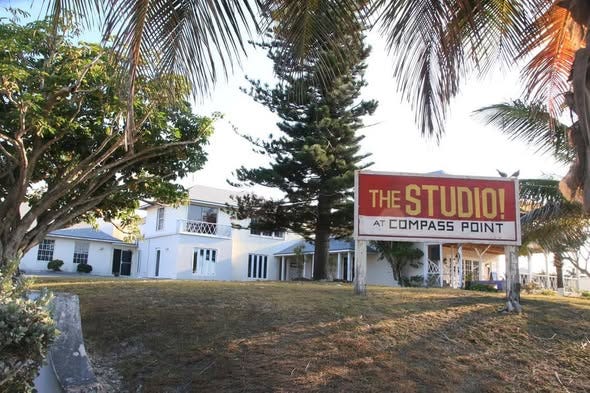
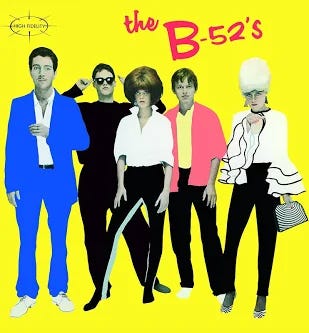
Three weeks after arriving in paradise, The B-52’s had a debut album.
Total cost: $10,000.
The re-recorded version of Rock Lobster was released as the albun’s leadoff single. It struck a second, more resonant chord with fans who’d grown tired of punk’s endless angst, with kids who preferred dancing to gnashing their teeth, with outcasts of every stripe and persuasion who felt a kinship with the misfits carrying on onstage.
The critics didn’t get it.
The band didn’t fit into their tiny boxes. The B-52’s didn’t sound or look like anything they’d seen or heard before. Since The B-52’s didn’t resemble a ‘real band’, and since critics are useless when it comes to new terrain, they dismissed the band as disposable camp. Fun? Sure. But let’s get serious.
Rock Lobster went on to reach #56 on the Billboard Hot 100. While it didn’t exactly cause a sensation, the song’s catchy riff, coupled with its driving and contagious beat, left a lasting impression on everyone who heard it.
One of those listening was a superstar. A man who’d retired from music for good.
John Lennon was five years into a self-imposed exile.
He’d spent the latter half of the ‘70s away from the toxic music industry, preferring to wile away his days baking bread, caring for his son, and being an exemplary house husband. He couldn’t remember the last time he’d touched a guitar. Nor did he care for the music of the day.
But in the summer of 1980, while on a rare vacation without Yoko, Lennon heard a song that reawakened his love of sound.
“I was at a dance club one night in Bermuda. Upstairs, they were playing disco, and downstairs I suddenly heard ‘Rock Lobster’ by the B-52’s for the first time. Do you know it? It sounds just like Yoko’s music, so I said to meself, ‘It’s time to get out the old ax and wake the wife up!’” – John Lennon, The Last Interview, Rolling Stone Magazine
Lennon released Double Fantasy in October 1980. It was his first album in five years, his first collaborative album with Yoko, and the last album he’d ever record.
Two months later, on December 8, 1980, Lennon was murdered by Mark David Chapman in front of The Dakota in New York City.
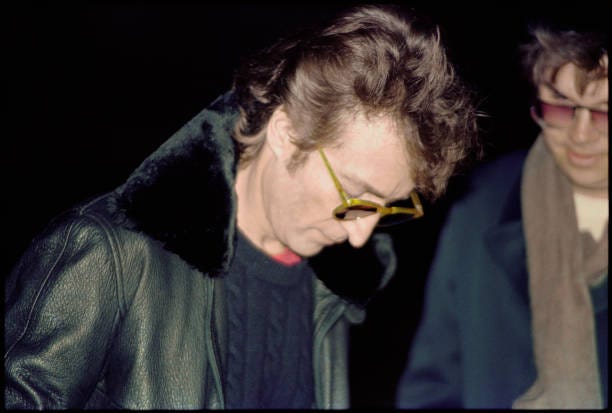
The band couldn’t believe it.
They read that last interview over and over and still it wouldn’t sink in. The fact they’d helped an actual Beatle reignite their creativity was an honor too bright to behold.
The B-52’s never met John Lennon. But they did eventually meet Yoko Ono, who was warm and friendly and proved that meeting your heroes doesn’t always have to end in disappointment.
Yoko became such a fan, she joined The B-52’s on stage during the band’s 25th anniversary. Naturally, she provided fish sounds for Rock Lobster.
What a thrill that was.
The rest of the band just stood and stared with undisguised awe.
They were witnessing the culmination of a dream, the circle of life performed in C minor, opening and closing and opening again, into the sandy yonder.
Aw, Sonny, that was excellent, thank you! I’ve loved the B-52s since 1982? They used to play “Rock Lobster” at junior high school dances…and we’d all go… “down, down, down”, and then burst up in some dance music ecstasy! And then in 1985, when I first heard “Planet Claire.” I wrote “I’m not no Limburger” on my neon green Tshirt and thought that was the most hilarious thing ever.
Thanks for the great writing and the jolt of nostalgia! I’ll be playing this record today!💕
Great read, thanks very much. Btw, current Garden & Gun has an excellent first-person verbal history of the Athens music scene by a number of the players. Fun, nostalgic, informative read (as was yours!): https://gardenandgun.com/athens-georgia-music