
Hey Man Nice Shot

Dear Gen Xer,
There’s a discrepancy of millions of dollars in the Commonwealth of Pennsylvania. Public employees have overpaid in Federal Insurance Contribution Act taxes and refunds are in order. Sounds like a job for Robert Budd Dwyer.
Dwyer’s an imposing figure. A Missouri boy with a winning smile and a university degree. He taught social studies. Coached high school football. Then he got interested in politics and realized he had a gift.
Three times he’s elected to the Pennsylvania House of Representatives. Then he’s elected three more times as a State Senator.
He keeps working hard. Keeps shaking hands. Climbs his way up the ladder to Pennsylvania Treasurer.
This error with the FICA taxes, this overpay by employees, happened in 1979, a year before Dwyer assumes the office. He spends his first term transforming the Treasury from an antique to a modern machine, a horse and buggy to a tricked out ‘Stang. Dwyer’s so charming and effective, he wins himself another term, stomping the second Democrat brave enough to run against him.
But now it’s 1984. State employees have yet to be repaid. Time to hire an accounting firm and make things right.
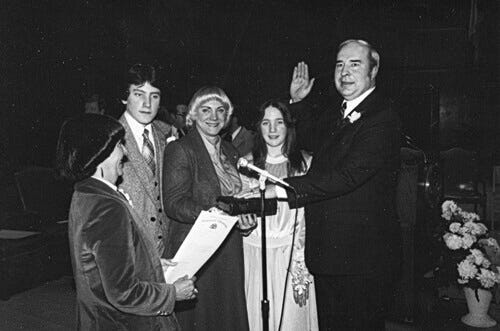
Dwyer awards a no-bid contract, worth a cool $4.6 million, to a company called CTA - short for Computer Technology Associates. The company is based in California and is owned by a man named John Torquato Jr.
It’s May 10, 1984.
Let the refunds begin.
Wait a sec—
Deep in the bowels of Pittsburgh’s public schools, Deputy Comptroller Dennis Schatzman notices a few irregularities.
Something doesn’t look right. Something smells rotten in the state of Pennsylvania.
Schatzman gives Pittsburgh’s school officials a concerned heads up. Then he reaches out to accounting company Arthur Young and Associates. Take a look, he tells their team. Maybe I’m imagining things.
Schatzman’s suspicions are confirmed.
One month after the deal went down, Arthur Young and Associates conclude that the no-bid contract CTA received is way overpriced.
Like millions and millions of dollars overpriced.
That’s a lot of Primanti sandwiches. Enough, anyway, for the Office of the Pennsylvania Auditor General to get on the horn with the FBI.
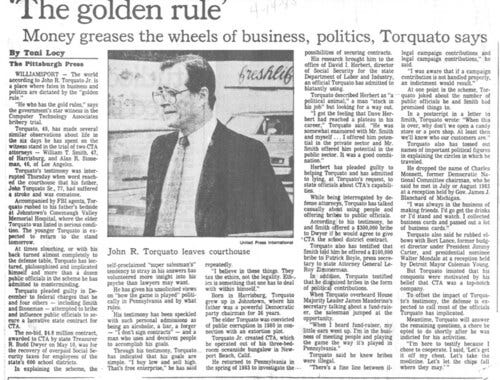
One month later - two months after the contract was signed - a former employee at CTA releases a sworn statement.
Janice R. Kincaid says that Pennsylvania Treasurer Robert Budd Dwyer gave the contract to CTA because he was promised a kickback of $300K. The hefty donation was offered by none other than CTA’s owner John Torquato Jr.
Ms. Kincaid also claims that her former boss offered a variety of gifts and bribes to numerous state and local officials. Torquato also directed the female workers on his staff to provide sexual favors to potential clients. Lord knows an obscure company with few employees and even less standing could use all the help it can get.
The FBI continues their search.
When State Treasurer Dwyer realizes the Feds are on his tail, he rescinds the contract with CTA.
He stalls and diverts, he shakes and shimmies, he floats like a butterfly and enlists the rope-a-dope — anything to stall the investigation and keep the contract’s stink at bay. He even tells his loyal staff to withhold information from the FBI and the U.S. attorney.
It’s no use, though.
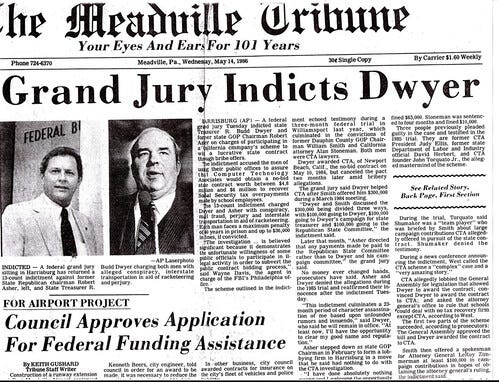
Dwyer is indicted.
Things get worse for Robert Budd Dwyer.
It’s revealed at his trial that he sought, fought for, and won approval for special legislation to recover the overpayments by state employees. The legislation allowed Dwyer to reward the contract to CTA.
This despite the fact that Arthur Young and Associates - the company that confirmed the contract’s discrepancies - had offered to do the exact same job for less than half the price.
Despite, as well, the 16 other companies who’d communicated interest in winning the contract. Who’d offered to do it at a competitive rate. Whom Dwyer never thought or bothered to call back.
Furthermore…
Computer tape from CTA proves that Dwyer was set to receive a payoff of $300K.
Four impartial witnesses corroborate the bribe.
Testimony from FBI agents reveals that Dwyer, upon learning of their investigation, dug up his appointment book and erased the entry on March 2, 1984: the day he met with John Torquato Jr.
The day he was offered a juicy bribe.
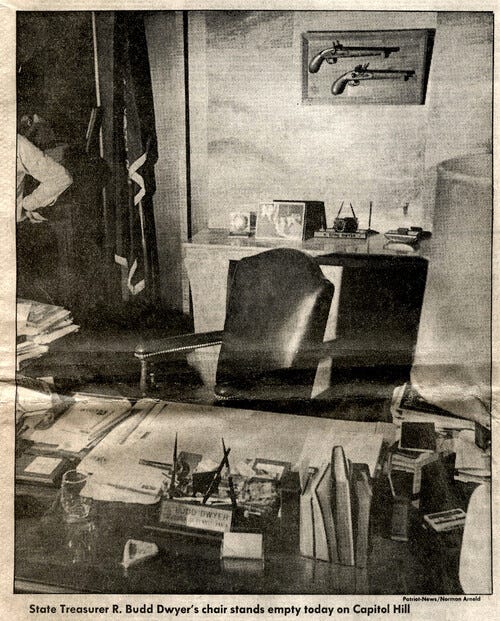
Dwyer is found guilty on December 18, 1986.
Eleven counts stick to him like Velcro with a grudge:
mail fraud
perjury
conspiracy
interstate transportation in aid of racketeering
He faces 55 years in the Big House. Plus a seemingly appropriate fine of $300K.
Dwyer expresses sadness. Signs of shock and disbelief. He swears that he is innocent; the victim of political assassination.
Three days before he’s sentenced, Dwyer sits down and composes two letters.
The first he sends to Congressman Peter W. Rodino. The second letter goes to Senator Joe Biden.
The two men serve, respectively, as the chairs of the House Judiciary Committee and the Senate Judiciary Committee. Dwyer begs them to conduct an investigation. If they don’t, Dwyer says, they might as well erase the word “justice” from anything involving the DOJ.
One day later, Dwyer pens another letter, this one to President Ronald Reagan. He states his innocence once again and begs The Gipper for a pardon.
The maddening sound of crickets ensues.
Dwyer asks his press secretary to arrange a meeting with the media. A conference is scheduled for the following day: the day before Dwyer is sentenced.
Dozens of reporters are invited to attend. All of them expect the State Treasurer to announce his resignation.
Nobody’s really sure, though. Least of all Dwyer’s secretary.
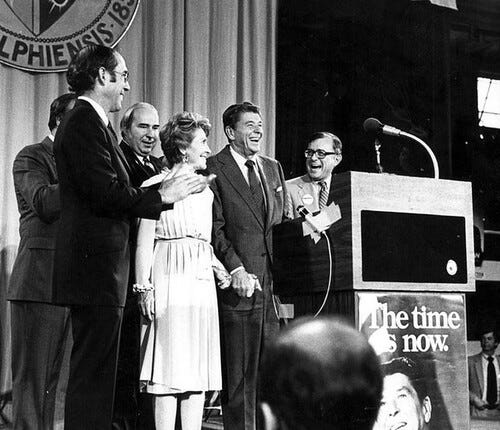
It’s a frosty morning on January 22, 1987 when reporters arrive at the Pennsylvania Finance Building.
A few of Dwyer’s aides hand the media a 20-page text written by Dwyer the night before. Dwyer watches from behind a wooden table. In his hands is a text as well. His is 21 pages.
Dwyer’s voice is firm as he begins to address the room. He looks a little agitated, though.
Maybe it’s nerves. Maybe it’s the lights from the TV cameras. Maybe it’s because he’s staring down the barrel of 55 years in the slammer.
Dwyer states his innocence for the umpteenth time. He accuses the media and the FBI of abusing the law and smearing his name. He claims that U.S. Attorney James West decided to hold his trial in Williamsport instead of Harrisburg because Williamsport is located in Lycoming County, and everybody knows that education is hardly the county’s strong suit.
Dwyer moves on to U.S. District Court Judge Malcolm Muir. He calls him out for his “medieval sentencing”, for saying he was “invigorated” when Dwyer was found guilty. Dwyer adds his profound regret for having voted in favor of the death penalty on numerous occasions in the past.
Fifteen minutes into his speech, half of the reporters pack up their gear and make to leave the room. Dwyer notices and interrupts himself. He tells the reporters he thinks they should stay. Won’t be long now, he says.
Dwyer powers through the rest of his speech. He scratches his face. Wipes away sweat. Races towards the finish line.
When he’s done, he calls three of his staffers over and hands them each a sealed envelope.
Then he reaches into a Manila envelope and draws out a Magnum revolver.
Everyone gasps. A few hit the deck.
Dwyer backs up against the wall. He warns those present that they should leave the room if they believe what he’s about to do will affect them.
Reporters and staff plead with Dwyer.
But he’s too deep to pull out now. The walls are closing in. So are his colleagues, who reach for the gun.
Dwyer tells them to stay away. “This will hurt someone,” he says.
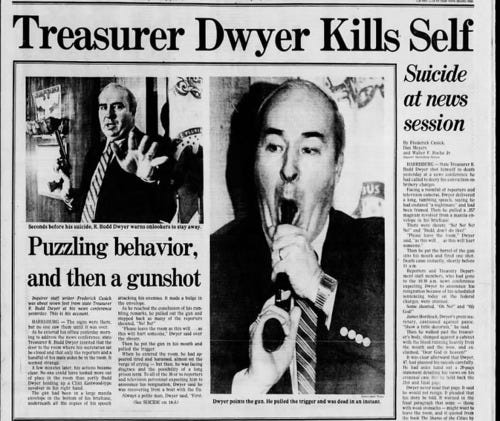
Then he sticks the gun in his mouth and is off to meet his maker.
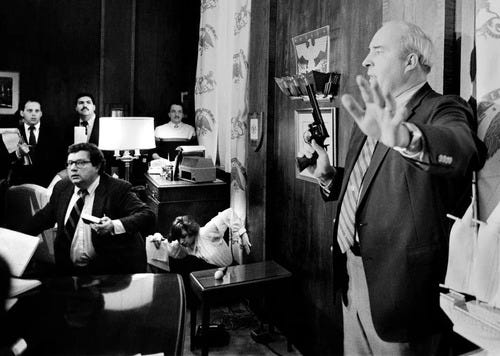
Nine cameras capture everything.
The single shot through the roof of Dwyer’s mouth. The inconceivable amount of blood pouring from his head.
Less than an hour later, in newsrooms across the state and country, editors wonder whether to air the grisly footage.
Some cut the tape before the gunshot. Others cut the tape but let the shot ring.
Action News, along with WPXI in Pittsburgh and WPVI in Philadelphia, broadcast the suicide footage in full. None of them think to warn their viewers.
Meanwhile, it’s storming in central Pennsylvania. The weather’s so bad, the schools have called a snow day.
Thousands and thousands of kids are at home. They’re having lunch. Munching on sandwiches. Watching reruns of Webster.
Then some geezer with a gun comes on.
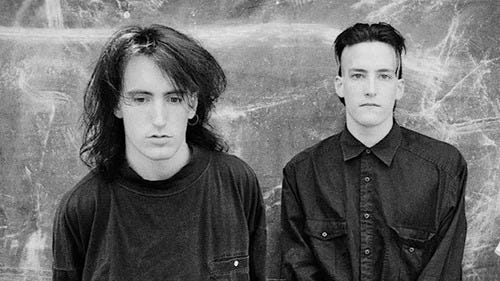
Richard Patrick’s watching that day.
He’s not a kid, he’s 22. But it’s not like people blowing their heads off is an everyday occurrence.
The footage scares him. Leaves a mark. In his mind pops the phrase: Hey man, nice shot.
Two years later, in 1989, Patrick meets a dude called Trent Reznor at a record store in Cleveland. They talk music and hit it off. So much so, that Reznor invites Patrick to join him on tour. Come and play guitar, he says. I’ve got this band called Nine Inch Nails.
Patrick plays live with Nine Inch Nails until 1993. Then he ditches Reznor and the gang while they’re recording The Downward Spiral. Patrick’s been hounding Reznor for money. Long enough that Reznor loses it. If you want some dough, Reznor says, why don’t you deliver pizzas? Better yet: get up off your ass and make an album.
OK, Patrick thinks. Challenge accepted.
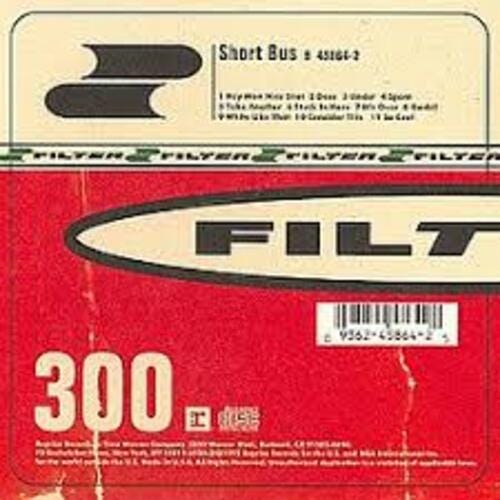
Patrick forms his own band and calls it Filter. Then he starts recording an album with the politically wonky name of Short Bus.
One of the songs he brings to the table is a ditty he wrote in 1991. He was tooling around on the guitar one day when he recalled the memory of Robert Budd Dwyer. His speech. The gun. The bullet in his head.
Patrick digs the old tune up. Then he records his first major hit.
Hey Man Nice Shot is the opening track on Short Bus.
It’s released in 1995 and strikes a chord with hard rock fans. The song stalls at #76 on Billboard’s Hot 100, but climbs all the way to #10 on Billboard’s Alternative Airplay.
The video provides a boost in popularity. So does speculation that the song is a nod to Kurt Cobain. The frontman for Nirvana had killed himself the year before. Most people figure that Filter is trying to cash in on the tragedy.
Richard Patrick is horrified. He’s not an asshole. He’s not a ghoul. He’s just a dude with a kickass tune.
He reaches out to Dave Grohl and Krist Novoselic. He swears from the bottom of his mortified heart that he wrote the song in 1991: three years before Kurt Cobain went and did the unthinkable.
Grohl and Novoselic believe him. They read his interview in Rolling Stone and felt that Patrick was being sincere.
Grohl even goes so far as to commiserate. He was blasted with the same accusations when people heard his band, Foo Fighters.
Few people remember Robert Budd Dwyer.
Those who were present that day, however, who were casually watching television, aren’t likely to forget.
Many still see the disturbing images looping around in their mind’s eye. They still hear the jokes that echoed across schoolyards the very next day:
What’s worse than a gun in the washer?
A gun in the Dwyer.
Thirty-nine years later, the decision to edit, package, and air Dwyer’s suicide, barely an hour after the fact, remains a subject for debate.
But there’s no question for anyone watching that cold and wintry day.
For them, Dwyer’s actions will always serve as the shot heard ‘round Pennsylvania.
I was standing in my parents house in Harrisburg, Pennsylvania watching WHTM TV getting ready to go to work and watched the suicide in real time, replayed several times and then the station went dark on my TV. My dad had a business that was a large advertiser on that station. I remember my father being so mad about the replays of the suicide that he pulled a huge ad advertising buy from the local station and national network. I can't believe the level of detail your story has. I've seen and heard the story reiterated since I was about 22 years old. What a crazy Valentine's Day story to read. I'm very into rock history, but never knew or maybe just don't remember the correlation speculation with Cobain's suicide. All my friends back in the day knew that the Filter song was about Dwyer. Great article , Sonny! Unrelated to Dwyer--Happy Valentine's Day to you.
I will never listen to this song without thinking of this. Really changes it.